
Message from the Vice Provost
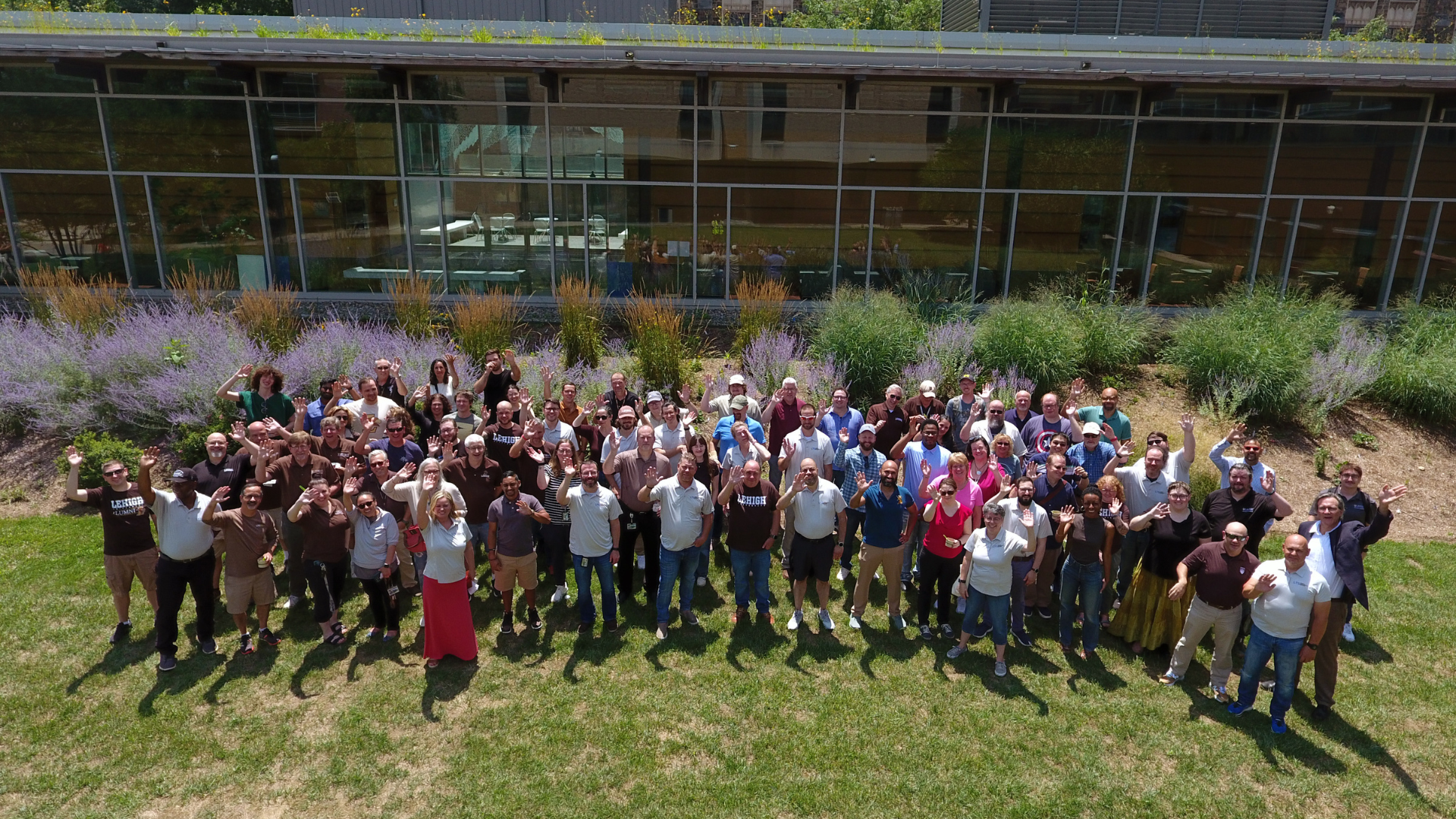
In this report, we review our accomplishments from the past academic year, highlighting LTS’s role in educating students, advancing research, producing and disseminating scholarship, and conducting the business of the university.
See how our work is contributing to Lehigh’s strategic plan’s goal to Make it New, to Make it Together, and to Make a Difference.
Greg Reihman, Ph.D.
Vice Provost for Library and Technology Services
Chief Information Officer
Strengthen Support for Research & Scholarship
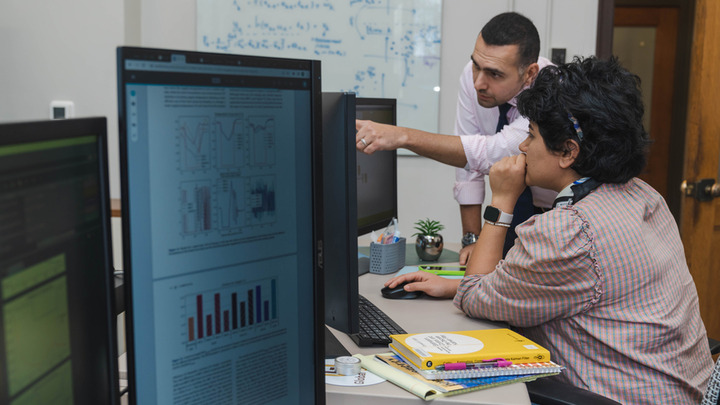
- Our high-performance computing (HPC) clusters, Hawk and Sol delivered 27M core hours on a shared platform that hosts:
- 172 nodes with 6964 cores
- 50 TB total memory
- 229 graphics processing units (GPUs)
- 4.2 TB GPU memory
- Hawk delivered 1.8M core-hours to Lehigh researchers and contributed 3.5M core-hours to the Open Science Grid.
- Faculty condo investors who helped build Sol consumed 22M core-hours.
- Over 50 research groups and courses with 450 unique students and faculty used high-performance computing resources.
- The Hawk cluster supported six courses with traditional HPC and Jupyter Notebooks delivered by the Open OnDemand web portal.
- Ceph storage systems provided 500 TB usable storage to researchers and staff.
- In support of emerging research areas, interdisciplinarity, and university initiatives, the Libraries acquired a range of digital primary source collections that expand access to diverse perspectives on global history, politics, and culture. Highlights include Gale collections on political extremism, women’s roles in World War I, the history of sex and sexuality, and post-war European refugee resettlement; archives focusing on Amnesty International and the colonial Caribbean from AM Explorer; and resources documenting Indigenous American experiences and 19th-century American drama. Additionally, new Policy Commons collections aggregate grey literature across the world and provide insights into global think tanks, public health, and governance.
- As part of a broader effort to expand public access to Lehigh University research, the Libraries have grown support for “Read & Publish” agreements, now including new partnerships with Elsevier, Emerald, the Royal Society of Chemistry, and Springer. These agreements combine subscription journal access with the ability for Lehigh authors to publish openly in many journals. This year, more than 130 articles by 90 unique corresponding authors were published Open Access, covering an estimated $450,000 in publishing charges. With global, unrestricted access, views of these articles increased dramatically, expanding the reach and impact of Lehigh research.
- In response to increasing systematic and scoping review activities across the university, Instruction and Outreach librarians developed an Evidence Synthesis Support service, assisting researchers across the stages of long-term projects. Evidence synthesis systematically gathers and evaluates existing research - often thousands of articles - to answer specific questions that may impact clinical practice and/or policy. This year's supported projects ranged in focus from interventions for adults with intellectual and developmental disabilities, to the impact of patient ethnic racial identity in psychotherapy, to AI use in higher education.
- Acquired the Robert Lichtman Science Fiction Fanzine Collection, containing approximately 20,000 items. This collection, one of the biggest and broadest collections of such material in the US, will provide plenty of new information for researchers and students alike for years to come.
- Digitized 820 recordings from Godfrey Daniels, one of the oldest and most respected acoustic music venues in the country. It has hosted thousands of concerts by folk, blues, jazz, bluegrass, Celtic, and world music artists, many of whose recordings have been donated to the Lehigh Libraries Special Collections. The collection includes hundreds of hours of audio recordings, as well as photographs, posters, flyers, artwork, and other memorabilia, much of which has already been digitized.
- Supported the use of Generative AI in 46 courses by developing custom web applications that access AI models from OpenAI at a reduced cost through their API. More than 800 users engaged with the applications.
- Supported five externally funded faculty research projects in three colleges.
- Supported the use of GIS technologies in 11 courses, and the integration of DataCamp in 18 courses.
- TRAC 100 Symposium (Fall 2024)—New fellows in our TRAC program enroll in TRAC 100, The TRAC Writing Fellows Seminar. Students tackle group inquiry research projects that engage them in the research and writing processes. Fellows presented their findings in a two-part symposium based on the questions “What makes a good story?” and “What are the benefits and limits of mindfulness in a learning process?” Fellows were guided by Sarah Joseph (’25, English) and Ella Rossetti (’25, Cognitive Science and Economics).
- TRAC 110 Symposium (Spring 2025)—During the spring semester TRAC Fellows have the opportunity to take TRAC 110, The Writing Process. Students work on a semester-long writing project that is self-designed and personally meaningful. The course culminated in a writer’s showcase in which each fellow presented excerpts from their work. Ella Rossetti facilitated the event.
timelinePhysical materials circulated from Library collections
14,862
timelineLoaner laptops circulated
703
timelineItems borrowed from other libraries for Lehigh researchers
3,589
Spark & Sustain Innovations in Teaching & Learning
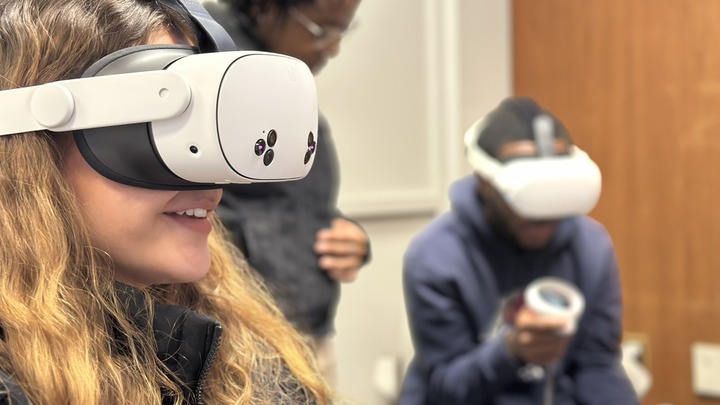
Lehigh’s 16th annual Symposium on Teaching and Learning brought over 100 faculty, staff, and students together to explore innovative approaches to education, with a focus on inquiry-based learning, extended reality (XR), and artificial intelligence (AI). Faculty Fellows presented their work through panel discussions on student curiosity, immersive technologies, and the evolving role of AI in the classroom, supported by CITL’s resources and expertise. The event also featured an interactive exhibit of student-created projects, highlighting the impact of CITL collaborations across disciplines.
Learn more about the Symposium, watch the Faculty Panel recordings, and view the event photo album at 2025 Symposium on Teaching and Learning
Each semester CITL invites faculty to submit proposals for collaborations with LTS staff to enhance and advance their use of emerging and instructional technologies in support of their pedagogical approaches. Faculty participation remained strong in 2024–25, with more than 34 faculty partnering with LTS staff across 30 projects. All five colleges were represented in these collaborations, which explored themes such as the use of generative AI, virtual reality and immersive learning environments, inquiry-based learning activities and assignments, cross-disciplinary course moments, and the use of LTS flexible learning spaces to promote active learning.
View faculty projects for fall 2024 and spring 2025.
Outreach Librarians:
- In Writing (WRT 3), students explored traditional library resources alongside ChatGPT and Perplexity to create their own fairy tales. Thoughtful discussions ensued regarding the evaluation of sources, including the strengths and weaknesses of generative AI tools. Tips for prompt engineering, as well as citing AI tools were shared.
- The College of Business's introductory course BUS 001, Foundations of Business, is designed to give students a solid understanding of key business concepts. As part of this effort, our business librarian presented during the "Career Research Resources" recitation. He shared valuable library resources and databases that students can use to research specific industries and occupations.
- To support the College of Arts and Sciences new Big Question Seminars, Lehigh librarians assessed and revised our seminar library guides, our primary teaching tools for the courses. Using best practices gleaned from focus groups, scholarship, and web analytics, key areas that changed were navigation, content, and flow. By centering the redesign on user needs, the new library guides aim to create more intuitive and effective guides that better support novice researchers.
Systems Engineering Capstone Technology Support
- Led a cybersecurity activity for the Computer Science and Business PreLUsion, combining a presentation on industry roles and outlook with a virtual capture-the-flag competition where incoming students solved challenges on an online platform to earn points and leaderboard rankings. Collaborated with vendors to provide free resources, including a cybersecurity-themed comic book and a career guidebook to help students explore pathways in the field.
- Mentored a Computer Science and Engineering (CSE) student team to develop a CSE Enrollment application designed to assist students with course planning. LTS provisioned a virtual environment, providing guidance on configuration for reliability, security, and version control best practices. The application was built with an extendable architecture to support future adoption by other departments and institutions.
- Collaborated with students from the P.C. Rossin College of Engineering and Applied Sciences Bioengineering department to set up the Seshadri Portal project to support gathering biometric and vitals data from wearable devices worn by student athletes on the field. Mentored the students on developing a Python Flask application deployed on highly available Python servers and a MariaDB database.
- Supported a Facilities and Electrical Engineering research project by enabling access to campus electrical system data through the Canary Labs Historian and Axiom web tool, and provided technical assistance configuring the Axiom API to integrate historian data with modeling software for system analysis in Packard Lab.
- The Artificial Intelligence Community of Practice met in October 2024 to hear faculty and staff voice their opinions on the best use of AI at Lehigh. A subcommittee selected winners of the Lehigh AI Project Awards in September. Lehigh AI in The Preserve launched in January 2025.
- The XR Community of Practice convened in both the Fall and Spring to discuss current developments in the fields of XR and immersive learning, both across higher ed and locally at Lehigh. Guest faculty speakers Dr. Larry Tartaglia (Biological Sciences) and Dr. Al Bodzin (Teaching, Learning & Technology) shared their work and experiences with XR in their teaching and research at Lehigh.
- The Virtual International Exchange (VIE) Community of Practice held one session in the Fall to introduce faculty to VIE and how it benefits students and research partnerships. We also invited faculty who have utilized VIE in the classroom to highlight their experience and student outcomes. Twenty faculty members attended this hybrid meeting.
- An AWS QuickSight Community of Practice was launched in July 2025 to help participants learn, explore, and share best practices for building dashboards and visualizations that support data-driven decision-making.
- CITL and The Office of Educational Innovation and Assessment co-sponsored a new network at Lehigh focused on the role of artificial intelligence within higher education learning environments. The Strategic Methods in AI-Responsive Teaching (SMART) community of practice empowers faculty and staff to critically and creatively integrate artificial intelligence into their instructional landscapes.
Our Writing Across the Curriculum program trained 28 new Technology, Research, and Communication Fellows as part of the 85-strong TRAC Writing Fellows program in supporting 43 courses and programs, 38 faculty members, and over 2,100 students in the fall and spring, including 6 large courses (Fall: BUS 003, ENGR 005, BIOS 115; Spring: BUS 003, BIOS 041, CSE 252). Students logged more than 700 individual and group conferences on the writing process.
In February, we unveiled the LTS Emerging Technologies (LETs) Lab in Fairchild-Martindale Library, a vibrant, collaborative hub where students, faculty, and staff can explore and experiment with cutting-edge technologies such as XR, Generative AI, GIS, and drones. The lab not only provides hands-on access and expert guidance from LTS staff, but also showcases the creative energy of CITL’s broader digital maker spaces, inspiring innovation and cross-disciplinary collaboration across campus.
LETs Lab and Creative & Experiential Spaces:
- Digital Media Studio
- XR Learning Lab
- DIY Podcasting & Lightboard Studio
- Student Developer Lab
- DIY Audio Recording Studio
- DIY Video Recording Studio
Bringing Emerging Technologies into Learning:
CITL partnered with faculty across 24 courses in all colleges to integrate virtual and mixed reality into the student learning experience. Students engaged with topics spanning social impact, historical and place-based learning, gaming, creativity and prototyping, productivity and collaboration, and more. In addition, CITL supported a number of programs and departments across campus with XR and immersive learning focused events totaling 122 hands-on sessions over the year.
Student Developer Lab:
More than 80 students were granted dedicated access to the Student Developer Lab, a collaborative space where imagination meets technology. Equipped with high-powered workstations and specialized tools, students developed and tested 2D and 3D games for Capstone projects, Creative Inquiry initiatives, independent exploration, and research, making the lab a dynamic environment for innovation.
Digital Media Studio
CITL staff in the Digital Media Studio (DMS) supported the Mothers of Sierra Leone project, co-directed by Dr. Fathima Wakeel (College of Health) and Dr. Michael Kramp (College of Arts and Sciences). During a recent trip, the team completed filming for postnatal and maternal care teaching modules. CITL staff provided hands-on training for students in filmmaking and guided project participants in the use of drone technology.
In addition to supporting faculty projects, the DMS remained a vibrant hub of creative and instructional activity throughout the year. The studio supported 51 courses across disciplines, hosting 179 class meetings and providing 327 hours of lab and instructional time. DMS staff loaned 2,144 pieces of equipment to students and faculty and contributed more than 530 hours to video, photo, and audio production.
timelineLehigh community members taught by instruction & outreach librarians
4,100+
timelineEvents held in the LETs Lab
60+
timelineUnique courses supported by TRAC Fellows
24
Systematically Improve Campus Technology, User Experience, & Cybersecurity
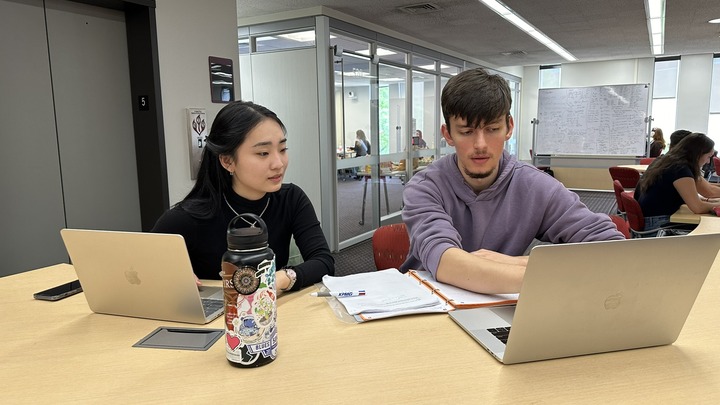
The following projects and initiatives highlight our work advancing operational excellence in support of the Organization of the Future strategic initiative:
- As a key component of Lehigh’s Strategy to create An Organization of the Future, LTS launched the Future Ready project—a five-year initiative to modernize the university’s Banner ERP and Student Information System by transitioning to a cloud-based SaaS platform. This upgrade will deliver near real-time data, streamlined processes, and faster updates, empowering faculty and staff to better support students and make informed decisions. With improved efficiency, scalability, and security, Future Ready will ensure a more seamless, agile, and student-focused experience across the university.
- Launched Zoom Phone, a cloud-based communication platform that replaced traditional desk phones with a flexible, software-based system accessible via computer or smartphone. The campuswide transition, completed in December, enhanced the university’s communications infrastructure with features such as voicemail-to-email, text messaging, expanded Zoom meeting capabilities, and seamless integration with existing Zoom tools. More about the project.
- In partnership with many departments across campus, LTS has taken significant steps to modernize campus commerce with the implementation of the Transact Ecosystem. Completed efforts include replacing the campus retail transaction system—impacting dining halls, the bookstore, vending machines, laundry, and off-campus retail—and preparing for a transition to a fully contactless ID card production system scheduled for the spring. This shift lays the foundation for expanded use of mobile devices such as smartphones and smartwatches, creating a more seamless and flexible experience for the Lehigh community.
- In collaboration with the Office of Inclusive Excellence and Belonging, we implemented an online scheduling system that allows our Lehigh community and visitors to view and schedule lactation and chestfeeding spaces across campus.
- We implemented a new Student Affairs Portal, powered by Atlassian Jira Service Management, in partnership with Student Affairs to streamline how student organizations and individuals request funding and report planned events. The portal provides a single, easy-to-use location to submit requests and track their status from initial submission through funding allocation and post-event reporting. This improves communication and ensures clear tracking of funds.
- Provided process improvement guidance and development work for the Reimaging Recruitment effort (Phases 1 and 2 complete). This included the creation of the HR portal.
- Significant progress was made in developing LADL (Lehigh Administrative Data Lake), an ecosystem of technologies within the AWS (Amazon Web Services) environment.
- Expanded the reach of the Chosen Name/Preferred Name functionality outside of the Banner ecosystem.
- Strengthened data protection, integrity, and availability to ensure a secure and reliable foundation for institutional decision-making.
- Migrated the data lake to a new AWS VPC, improving integration with enterprise applications and databases. Also expanded data lake initiatives focused on student retention by aligning new datasets to enhance insight and intervention capabilities.
- Further developed Ellucian Experience (Connect Lehigh) with additional functional cards including the Confidentiality Card and the First Year Student Checklist.
- Integrated the following systems with Banner: Via TRM, Syntellis Axiom (RAPTOR), and Interfolio.
- Implemented automation during the Zoom migration to update the e911 database, ensuring that 911 location data refreshes automatically whenever physical phones are relocated.
- To meet growing student internet and research needs, upgrades are underway to the university’s Internet Service Provider (ISP) and Internet2 research network connections, increasing capacity to 100 Gbps to support continued campus expansion.
- Replaced the nearly 20-year-old EWFM Data Center cooling system with new, energy-efficient units that deliver the enhanced cooling capacity required to support High Performance Computing.
- Implemented the Atlassian suite of tools, including Jira, Confluence, Trello, and more, as Lehigh’s preferred project management platform for faculty and staff. These tools improve visibility, streamline workflows, enhance collaboration, and increase efficiency across the university.
- Developed and deployed chatbots for LTS, Auxiliary Services, and Human Resources to provide 24/7 answers to common questions, improving customer service, reducing wait times, and allowing staff to focus on higher-value support.
- LTS staff taught 122 seminars with 1,851 attendees, highlighting popular topics such as Zoom Phone Basics, Gemini productivity, AI safety, AI for spreadsheets, and Jira project management.
- Co-sponsored the 24-hour Lehigh Valley Hackathon, held in October at Mountaintop Campus, bringing together nearly 100 students from Lehigh and regional universities to collaborate on projects focused on enhancing college life. Sponsored by Amazon Web Services and supported by Lehigh’s Computer Science and Business honors program, the event challenged participants to develop innovative solutions in areas such as academic success, wellness, campus resources, financial management, and student engagement. Judged by faculty and technology professionals, the competition awarded $1,300 in prizes.
- LTS led the launch of ai.lehigh.edu, a new website offering guidance, recommendations, and key policies for the responsible use of Generative AI in teaching, research, and administrative work. The site also highlights recommended AI tools, support resources, and best practices to help the Lehigh community explore AI effectively and securely.
- Sponsored by LTS with support from multiple university offices, the inaugural AI@Lehigh Summit brought together more than 150 faculty and staff in January to explore the effective and ethical use of generative AI. The event featured a keynote, panel discussions, and collaborative sessions on AI applications in professional, administrative, teaching, learning, and research contexts, along with related opportunities and concerns. Learn more about the Summit, read the recap, and watch panel recordings at AI@Lehigh Summit 2025.
- Lehigh AI was launched this year in The Preserve as a digital hub to support collaborative efforts in teaching, research, and community engagement. As part of this initiative, 61 proposals were submitted from across all colleges and several interdisciplinary programs. Of these, 20 projects received funding, representing 26 contributors—15 faculty, 4 staff, 4 undergraduate students, and 3 graduate students. These projects span AI applications, ethical considerations, and opportunities for social good, with each focusing on teaching effectiveness, innovative AI research, or community engagement initiatives that benefit Lehigh and broader communities.
- Lehigh participated for the first time in ICPSR’s International Love Data Week, hosting a series of events designed to increase data literacy and explore responsible data use. Library and Technology Services, the Lehigh Data Literacy Future Makers Grant Team, and Career Enrichment (CE@L) partnered on programming that explored the themes Whose data is it anyway? and You make history. Activities included workshops for faculty and staff, a presentation on Large Language Models and AI agents, hands-on data analysis sessions, and a Douglass Day transcribathon, all aimed at building practical skills and fostering engagement with data across the campus community.
- With a focus on research literature searching, summary, and analysis, the Instruction & Outreach librarians investigated a range of AI tools and held LTS seminars exploring their benefits, limitations, and use cases. Beyond tools, librarians have facilitated learning sessions on AI literacy spanning different audiences, from undergraduates to staff, and authored a library guide detailing different approaches to the evaluation, ethical use, and purposes of AI.
- In March, we launched Lehigh Cybersecurity Spotlight, a new newsletter offering timely tips on cybersecurity, privacy, and fraud awareness. Covering topics from seasonal threats to security best practices, the series provides the campus community with practical guidance to stay safe online, protect personal and financial information, and make effective use of University security tools.
- In spring 2025, LTS implemented Admin By Request (ABR) across all colleges and administrative areas. This security tool for University-owned Windows PCs helps prevent accidental installation of malicious software by requiring review of programs that modify sensitive system files, strengthening campus-wide cybersecurity.
- Launched the Islandora based Lehigh Preserve as a unified digital repository platform for library staff to manage and provide access to special collections and archive items, faculty and student publications, research data, and other teaching and scholarship materials. The redesigned library digital repository includes many innovative solutions, such as integration of OpenAI tools into the existing repository workflow to automatically transcribe audio/video files and manuscripts.
- Actively participated in and contributed to open-source library technology projects, such as FOLIO, VuFind, and Islandora. The Library Technology team developed many new tools that not only improve the discovery and access of Lehigh library resources, but also provide valuable solutions that benefit peer academic libraries and the broader library community.
- Digital Media Studio (DMS) staff designed, relocated, installed, and tested two new creative spaces—a photo studio and a videography studio—and added a video podcasting suite to the self-service video and lightboard studio.
- The DMS tested generative AI tools for text, image, video, performance capture, audio narration, and noise reduction. Demonstrations of Google Veo and Flow highlighted advances in AI-driven video generation, including integrated dialogue, sound effects, and music, while staff developed consistent prompting methods for continuity in visual and audio design.
- For the AISHA, Childhood of the Future, and Friends and Connections projects, CITL’s professional photographer and videographer trained students in green screen filming and editing techniques in the new videography studio.
- Continued emphasis on migrating websites from Drupal 7 to Drupal 10.
- Custom web projects completed for:
- Office of the Vice Provost for Research: Upgraded website to Drupal 10, incorporating custom displays and implementing a comprehensive content strategy.
- Centennial School: Transitioned website to Drupal 10 using the College of Education’s theme.
- Office of International Affairs: Migrated custom website to Drupal 10.
- Current Status:
- 18 websites remain on Drupal 7.
- 112 websites are now operating on Drupal 10.
- Endpoint consulting/configuration
- Accounts
- Duo two-factor authentication
- General/non-LTS
- Course Site
- Software
- Laptop loans and repairs
- Enterprise applications
- Instructional technology in classrooms
- Printing
timelineLogins protected with Duo two-factor authentication
6.45M
timelineTotal LUapps launches
33,599
timelineSTARS student computing help requests
508
Create & Cultivate Connections
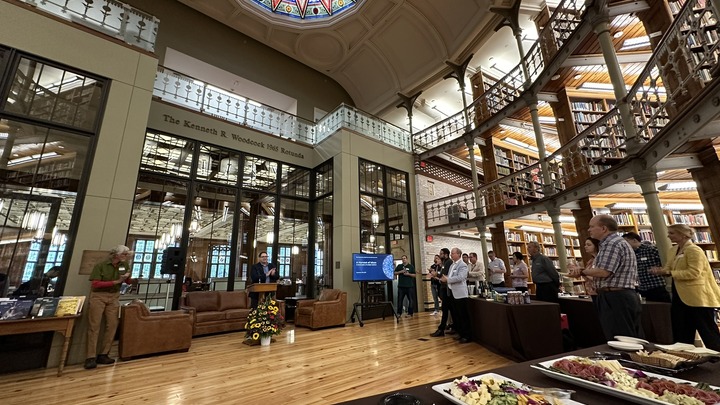
The Friends of the Lehigh University Libraries are dedicated to enhancing and extending high-quality library services through unique campus programming and the support of innovative projects. Their contributions fund author visits, faculty and student readings, rare book conservation, exhibits, and talks by scholars, artists, and Lehigh faculty for the benefit of both campus and community. Become a Friend!
The Friends hosted the following events this year:
- 13th annual Harvest of Ideas reception, September 17: A celebration of Lehigh faculty who published or edited a book or composition during the previous year, held in the Linderman Library Rotunda. Read the story and view event photos.
- MADE IN AMERICA, October 23: Photographer Christopher Payne discussed the making of MADE IN AMERICA, a celebration of American manufacturing, craftsmanship, and ingenuity. The talk coincided with an artist workshop and solo exhibition of Payne’s photography in the Fairchild-Martindale Library. Read the story and watch the recording.
- Hope Is the Thing With Feathers: How Bird Watchers and AI Are Reshaping How We See and Conserve Birds, November 6: Dr. Miyoko Chu, Senior Director of Communications at the Cornell Lab of Ornithology, discussed how AI technology, digital platforms, and bird enthusiasts are transforming global bird conservation efforts. Her talk coincided with the Special Collections Feathers and Folios exhibit in Linderman Library. Watch the recording.
- The Civil War Correspondence of Charles Lamborn and Emma Taylor, March 19: Dr. Richard Upsher Smith discussed the recently discovered Civil War correspondence between Charles Lamborn and Emma Taylor, which provided insights into military campaigns and life on the home front between 1861 and 1865. Watch the recording.
- Worlds We Build Together: Sci-Fi Fandom, Fanzines, and the Culture of Connection, April 23: Phoenix Alexander and Pete Balestrieri discussed the 100-year history of science fiction fandom and fanzines, their use in classrooms and communities, and celebrated the Lehigh Libraries’ 2024 acquisition of the Robert Lichtman Science Fiction Fanzine Collection. Watch the recording.
The Friends also made possible the Confronting Race, Gender & Ability Bias in Tech talk with Meredith Broussard and Keywords for Black Louisiana: Witnessing Black Life & Community, a conversation with Jessica Johnson, both co-sponsored with the College of Arts and Sciences. They also supported the panel discussion LUally Gender and Sexuality Foundations with Lehigh's Pride Center and the Lichtman Sci-Fi Fanzine exhibit, further enriching learning and engagement across campus.
- For the second year in a row, Library and Technology Services received the prestigious Library Excellence in Access and Diversity (LEAD) Award from Insight Into Diversity magazine, recognizing its leadership in fostering inclusion, accessibility, and belonging. The award highlights LTS’s ongoing initiatives—from diverse collections and community events to accessible technologies and equitable hiring—that create welcoming spaces and equitable access to resources for all members of the Lehigh community.
- The LTS Diversity and Inclusion Committee led and supported a variety of initiatives, programs, and events this year:
Campus Partnerships & Initiatives: The committee introduced the Sit-downs with Campus Groups program to connect with Lehigh partners engaged in diversity and inclusion work, and refreshed the LTS Buddy Program, which connects LTS employees with mentors throughout their Lehigh careers. Committee members also participated in an Empathy Mapping session, a collaborative exercise that helps organizations better understand the needs, perspectives, and experiences of the people they serve.
Funding & Sponsorships: In AY24-25, we provided support for a 5x10 event offered by the Society of Asian Scientists and Engineers, and for the Polynesian Student Alliance’s LU’au, which promotes AAPI awareness. The committee also co-sponsored a faculty panel on Trees and Green Spaces, held in the LTS CIRCLE during Earth Month. View the recording.
Workshops & Presentations: Committee members attended the first annual College of Business Managing Diversity and Inclusion in the Workplace (MGT363) poster presentation and hosted staff workshops, including Gender and Sexuality Foundations, Cakes and Promotions: Building an Inclusive Workplace with the Center for Gender Equity, and a Lunch and Learn with Brooke E. DeSipio from Survivor Support and Intimacy Education.
- Meetings & Events: The committee organized a D&I potluck, added current events discussions to monthly meetings, and participated in the youth-led VOiCEup Berks STAR (Stand Together Against Racism) workshop, which fosters dialogue on allyship, racism, and ways to support marginalized communities.
- In celebration of diverse voices and communities, library staff continued expanding collections in the LTS CIRCLE and in our OverDrive ebook and audiobook library. These collections—featuring cultural heritage months as well as other thematic observances, such as National Poetry Month and the New York Times Top 100—are carefully selected to provide thoughtful context and multiple perspectives on complex historical and social issues. Over the year, print materials in the CIRCLE received 100 checkouts, and the OverDrive digital library saw 906 checkouts and 292 unique users.
Special Collections engaged the Lehigh community through a variety of events designed to highlight the richness of its archives and collections. First-year students were introduced to primary source materials through 5x10 sessions on topics ranging from early maps of the Age of Discovery and zines marking moments of transformation, to AI as a tool for deciphering historical documents.
Open houses invited the campus to explore themes such as the Lehigh–Lafayette Rivalry, Halloween “Dungeon of Curiosity” trivia, and the question What’s So Special about Special Collections? Additional programming included the Robot Dreams movie night with Lehigh After Dark and an ERAC K@N exhibit tour of the Hill-to-Hill Bridge, broadening opportunities for discovery and connection.
Lehigh Libraries Special Collections curated a number of exhibitions this year:
- Opening in the fall, Feathers and Folios explored the ways birds have inspired worship, observation, science, and storytelling throughout history. Featuring works by John Gould, John James Audubon, Hans Christian Andersen, and others, the exhibit highlighted how art, literature, and citizen science together shaped the field of ornithology. Complementing the exhibit, Dr. Miyoko Chu of the Cornell Lab of Ornithology delivered the talk Hope is the Thing with Feathers, examining how bird watchers and AI are reshaping conservation efforts worldwide.
- In January, Special Collections unveiled the Robert Lichtman Science Fiction Fanzine Collection, featuring over 15,000 items, including fan fiction, criticism, correspondence, original artwork, and material related to international Worldcons. In the spring, the collection was showcased through the exhibits Galaxy of Ideas in Linderman Library and Building Worlds, Building Community in E.W. Fairchild-Martindale Library. The collection strengthens Lehigh’s national prominence in science fiction research and supports interdisciplinary study of fandom, gender, network analysis, and cultural history.
- Bridging Bethlehem: Hill to Hill Bridge at 100 was a special collaborative exhibit between the Lehigh Libraries Special Collections and the Moravian Archives commemorating the 100th anniversary of Bethlehem’s iconic Hill-to-Hill Bridge. The exhibit was displayed in Linderman Library’s Bayer Galleria and at the Moravian Archives from October 2024 through December 2025, with the Moravian Archives presentation continuing through March 2026.
- LTS launched a student design competition for a new art installation in the Fairchild-Martindale Library, inviting submissions that reflected our Strategic Plan and fostered creativity and interdisciplinary collaboration. In February, Holly Fasching ’26 and Kenna Macdonald ’27 were announced as the winners for their design Mossgrove and will work with Capstone students and faculty advisors throughout the fall 2025 semester to refine, prototype, and construct the installation. LTS recognized their achievement with a $600 award for each student.
- On March 25-26, LTS participated in Giving Day + March Mania: Combined Challenge for Lehigh to support dynamic student spaces that foster learning, creativity, and community, from the LETs Lab and LTS CIRCLE to the XR Learning Lab and DIY Studios. We reached our goal of 50 donors, unlocking a $500 gift from Vice Provost Greg Reihman and celebrating with a pizza giveaway to students during finals.
- The Lehigh Libraries hosted a solo exhibition, Eighteen Months of Exploration, featuring twenty-one original oil paintings by Greg Skutches, retired former Director of Lehigh’s Writing Across the Curriculum, throughout study spaces in Fairchild-Martindale Library. On March 26, Skutches gave a talk in the LTS CIRCLE reflecting on his lifelong passion for art, his career at Lehigh—including co-founding the TRAC Writing Fellows Program—and how retirement launched his “encore career” as a painter.
- Each April, the Lehigh Libraries celebrates National Poetry Month in April with poetry readings, scholarly talks, and workshops. This year’s highlights included a virtual Poem in Your Pocket Day, an author talk with Robin Gow in collaboration with The Pride Center’s Lavender Book Club, where Gow discussed his novel in verse, A Million Quiet Revolutions. The celebration also featured a Sonnet Slam to launch the 2025 issue of Amaranth, and poetry selections were highlighted in the LTS OverDrive Collection and a specially curated LTS CIRCLE display, offering the campus community multiple ways to engage with poetry throughout the month.
LTS and the Libraries hosted a series of interactive 5x10 events for first-year students, offering opportunities to explore campus, reflect on identity, and build research skills.
- Trees of Lehigh: A Walking Tour of Lehigh’s Green Spaces — Guided by the University arborist, students explored Lehigh’s stewardship of its forest resources, from historic and rare species to the environmental challenges facing campus and global green spaces.
- Who Are You? Where Do You Come From? Where Are You Going? — Using Ancestry Library Edition, students learned to trace their family histories as a way to reflect on personal identity and future goals.
- Linderman Library Search Party! — A scavenger hunt introduced students to Linderman’s collections and digital resources, building skills in locating, retrieving, and exploring information.
The Library Welcome Committee, a cross-unit group of library staff, continued an expansive range of programs designed to foster community, creativity, and well-being. The Committee:
- Bookended the year with the Club Expo and the April Farmer's Market, outdoor outreach events that highlighted library services and resources to students, families, and the Southside community.
- Held six reading parties -- events where participants read the book of their choice and then connect with other readers to share their reading -- with two parties in partnership with student book clubs, Chapters and Chats and the Lavender Book Club.
- Developed a series of mindfulness-promoting programs, including a Mindful VR Break with CITL, a Lower Light Study Spaces session, a Mindful "Paws" break with UCPS, and a focus-oriented Board Games open house.
timelineEvents held in the LTS CIRCLE
21
timelineLehigh faculty authors celebrated at Harvest of Ideas
18
timelineDonors supporting LTS on Giving Day+March Mania
52
Looking Ahead to 2025-26
In 2026 we will continue to strategically integrate emerging technologies, ensuring Lehigh remains at the forefront of innovation. We will advance our digital transformation work to strengthen and modernize core systems to deliver a seamless, agile, and student-focused experience across campus. We will deepen our commitment to an AI-ready campus, expanding resources and empowering our community to explore these powerful tools ethically and effectively in teaching, research, and university operations. And we will continue to create inspiring spaces across our Libraries that invite the Lehigh community to not just adapt to the future, but to actively make it.
Greg Reihman, Vice Provost for Library and Technology Services
LTS Strategic Plan 2023 +
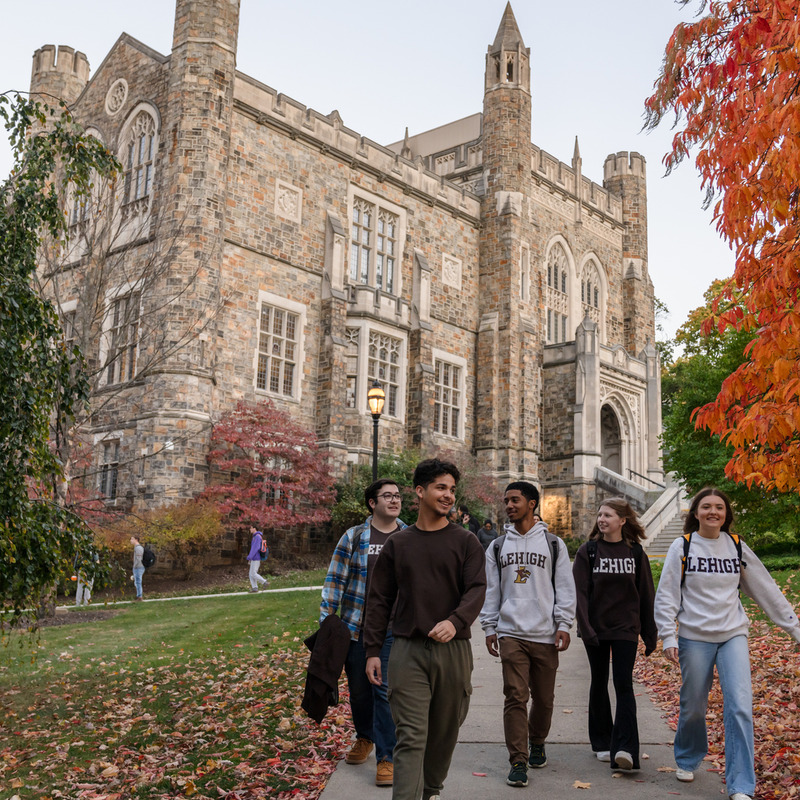
LTS offers a rolling “2023+” Strategic Plan to share who we are and what we’re committed to in the years ahead. Updated annually, it adapts to evolving campus needs, new technologies, and Lehigh’s Strategic Plan while staying grounded in our mission, vision, values, and goals. Lehigh’s future calls for bold innovations in education, stronger equity and inclusion, expanded research and graduate programs, enhanced student success, and data-informed decision making. Meeting this moment means access to technologies, resources, guidance, and spaces that inspire. As trusted partners, LTS is committed to empowering Lehigh’s faculty, students, and staff.
Acknowledgments: The LTS Annual Report was edited by Kathleen Frederick, with content provided by LTS leadership and managers and editorial support from Helen Zuercher.