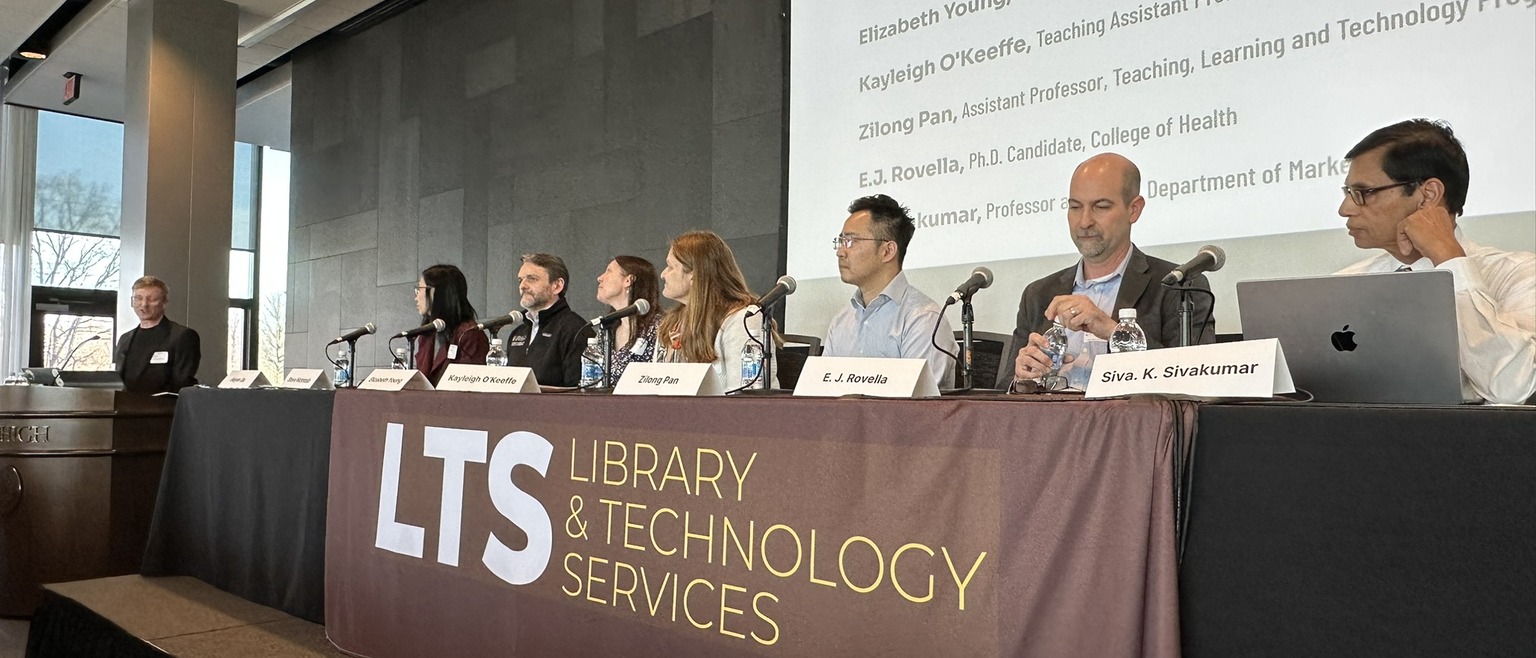
On January 13, more than 200 faculty and staff gathered at Iacocca Hall for the 2nd Annual AI@Lehigh Summit, an event focused on the practical, ethical, and transformative ways generative AI is reshaping the university’s academic and administrative landscape.
The summit opened with remarks from Greg Reihman, Vice Provost for Library and Technology Services and Lead for An Organization of the Future Strategic Initiative.
Reihman described the event as an “idea generator” that creates space for the Lehigh community to share successes, wrestle with challenges, and begin charting a path forward for an AI-integrated future.
“The goal of this summit is not to be a training workshop—it’s a conversation and a reflection,” said Reihman. “We want you to walk out with one thing you can bring back to your team, one thing that might not be right for your area and the reasons why, and a sense of curiosity about what you still need to learn.”
A Transformative Shift: Beyond the Internet
During the opening session, Nathan Urban, Provost and Senior Vice President for Academic Affairs, emphasized the scale of the technological shift now underway, describing artificial intelligence as a force already reshaping how work is done at Lehigh.
To illustrate that shift, Urban shared a personal example: after a colleague suggested he try Gemini to analyze complex admissions data, the tool generated insights and visualizations in minutes, work that previously would have taken far longer. “The ability to go from data to insights to actionable insights, to knowledge that we can use is really impressive and really important,” he said.
Urban placed the moment in a broader historical context, likening AI’s impact to earlier technological revolutions and emphasizing how Lehigh will both adapt and lead in this new era. “If you think about pre- versus post-internet,” he said, “I think AI and its incorporation is going to be a more significant change than the introduction of the internet.”
He stressed that AI adoption is essential not only for institutional effectiveness, but for preparing students to succeed in research and future careers. “We as a university need to be thinking about this both in terms of the work that we're doing and how we're training our students… so that they can be as competitive as possible,” Urban said. He also highlighted upcoming investments, made possible through the generosity of Hyo Sang Lee MS’76 Ph.D.’80 and his family, that will expand access to advanced AI tools for faculty and graduate students, and create opportunities for students to engage with local companies and organizations to apply AI technology to real-world challenges.
He also addressed common anxieties about AI and job displacement: “It’s not so much that AI is going to take your job, but that someone who knows how to use AI will take the job of somebody who does not.”
Putting AI to Work: The Future Maker Grants
The summit’s morning panel, "Using AI in Administration and Operations at Lehigh," featured the first cohort of AI Future Maker Grant recipients. These projects, with technical assistance from Library and Technology Services, represent applied approaches to solving institutional challenges where accuracy, consistency, and human judgment remain paramount:
- Institutional Data: The Office of Institutional Data is exploring "natural language querying" to allow staff to interact with university data without needing to know complex SQL code.
- Legal Efficiencies: The Office of the General Counsel is testing AI tools like Spellbook and Wordsmith to assist in the initial assessment and redlining of contracts, aimed at reducing backlogs.
- Research Visibility: The College of Engineering is developing a chatbot to "unlock" data from faculty CVs, making it easier for prospective graduate students to find research mentors.
- Consistent Communication: Communications and Public Affairs is creating a tool to help the university’s marketing professionals maintain a consistent Lehigh brand voice across all digital platforms.
"These projects did not start with the technology," noted Chief Technology Officer Ilena Key, who moderated the panel. "They started with the people and the work where time is limited and information is complex. The question was whether AI could support this work in meaningful ways while still honoring trust, policy, privacy, and the role of human judgment."
That spirit of experimentation continued into an afternoon workshop, where participants shared use cases in their own departments, along with questions and concerns about AI adoption.
Grounding Innovation in Principles
A key portion of the summit focused on the Lehigh AI Principles, a framework designed to guide responsible, values-aligned use of AI across campus. Chris Cook, Vice President for Finance and Administration, Dominic Packer, Associate Vice Provost for Educational Innovation and Assessment, and Greg Reihman shared their perspectives on how these principles inform decision-making.
“These are principles about how we operate at Lehigh anyway,” said Cook. Just as employees wouldn’t leave sensitive information—like salaries—on their front door, she noted, they shouldn’t treat data differently because AI is involved. She encouraged the audience to “trust your gut” and consider who is receiving the information—“the ‘who’ is AI in this case.”
Dominic Packer underscored the importance of assessment and mission alignment, emphasizing that technology should serve Lehigh’s core human goals. “We should find out whether [AI] really does produce a better outcome or not,” he said. “Assessment really has to be a big part of everything.”
Reihman highlighted the need for role-specific ethical awareness. “As a university, we can’t make a broad statement beyond the ethical,” he explained. “Know what the ethical guidelines are for your work, your team, your profession, and creatively figure out how AI now fits into that existing framework.”
These principles—which require AI to be used lawfully, ethically, and securely—sparked an engaging Q&A. Faculty and staff raised questions about data privacy, bias, and transparency. Reihman encouraged the community to “ask early and often” when dealing with sensitive data, and to maintain a “human-in-the-loop” at every step.
AI in the Classroom: Redefining the Student Experience
Moderated by Dominic Packer, the second panel, “Using AI in Teaching and Learning at Lehigh,” explored how AI is reshaping pedagogy, shifting conversations away from fear and enforcement toward intentional learning design. Panelists emphasized the distinction between students as knowledge consumers and knowledge producers, arguing that while AI can support advanced projects and creative work, it shouldn’t replace the productive struggle required for foundational learning.
Several faculty members stressed that reading, writing, and problem-solving remain essential processes students must experience firsthand. In journalism courses, for example, students compared AI-generated news stories to their own work, using the gaps and errors to sharpen their critical judgment. In engineering and science courses, instructors described using AI to handle routine calculations so students could focus more deeply on interpreting results. As one panelist remarked, “We don’t need your perfect writing. We have AI for that. What we want is your voice.”
A recurring theme was prioritizing process over product. Faculty described grading practices that allow room for imperfection and reflection—approaches designed to ensure AI complements learning rather than shortcuts it. One example came from the panel’s librarian, who shared how she uses AI-generated search results as teaching tools, inviting students to question source quality and bias instead of accepting outputs at face value.
Across disciplines, panelists agreed that effective AI use depends on context, transparency, and deep subject knowledge. Together, these examples reinforced a central message: while tools may evolve rapidly, human judgment, creativity, and critical thinking remain at the core of teaching and learning.
A Call to Action
At the close of the summit, Reihman encouraged participants to approach AI with curiosity and care, resisting both overhyped optimism and doomsday thinking. Drawing on the Gartner Hype Cycle, which describes how new technologies often move from inflated expectations through disappointment before settling into a stable “plateau of productivity,” he urged the campus community to focus on long-term value rather than short-term extremes.
From that foundation, he challenged attendees to make deliberate, written commitments about how (and how not) to use AI in their work. “Aim for the plateau,” Reihman said, calling for thoughtful, realistic decisions that support sustained success for both individuals and the institution.
The 2nd Annual AI@Lehigh Summit was sponsored by Library and Technology Services with support from the Offices of the Provost, Strategic Planning and Initiatives, Educational Innovation and Assessment, and Finance and Administration.
AI@Lehigh Resources
- To view the recordings, panelist resources, and slide deck from this event, visit the AI@Lehigh Summit 2026 page.
- For an overview of Lehigh’s approach to AI, visit ai.lehigh.edu. The site features recommended AI tools, responsible use policies, best practices, and resources for teaching, research, and learning with generative AI.
- The Center for Career & Professional Development has launched AI Ready, a new learning initiative designed to help Lehigh students build real-world AI skills through LinkedIn Learning pathways at every level. Get started.
- Join Library and Technology Services for AI office hours held via Zoom on the last Friday of every month through April.
- For upcoming AI seminars, visit LTS Seminars.
- Join the Strategic Methods for AI-Responsive Teaching (SMART) community of practice, open to all individuals regardless of their prior familiarity with and/or use of AI. Sign up by Jan. 30.
- Learn how Lehigh’s AI Readiness initiative is shaping ethical, practical AI learning for students and faculty, from the classroom to career preparation. Read the story on Lehigh News.