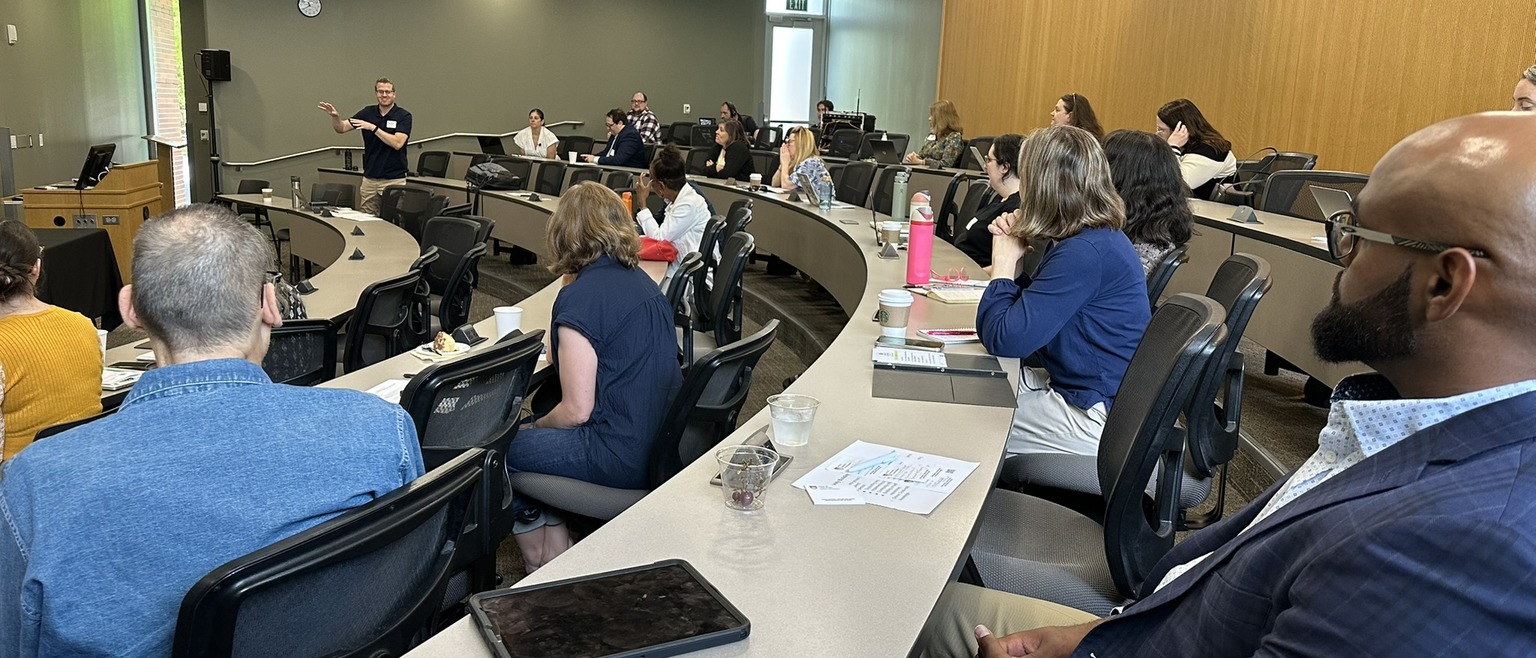
Educators, librarians, researchers, and technologists from institutions across the region gathered at Lehigh University's STEPS Building on June 17 for the second annual Lehigh Valley Open Knowledge Symposium, a day-long event focused on the opportunities and challenges surrounding open knowledge in higher education and beyond.
Sponsored by Lehigh University Libraries and the Lehigh Valley Association of Independent Colleges (LVAIC), the symposium brought together this diverse regional coalition to explore a broad range of topics, including open access publishing, open educational resources, open-source software, institutional repositories, and the evolving political and technological landscape surrounding free access to information.
Throughout the day, speakers emphasized that openness is not simply about making information available. Rather, they argued, sustaining open knowledge requires stewardship, collaboration, trust, and a shared commitment to ensuring information remains accessible, reliable, and useful.
A Question of Trust
The event was opened by Phillip Hewitt, Lehigh's Senior Open Knowledge Librarian, who welcomed attendees and guided the day's program. In opening remarks, Boaz Nadav-Manes, Lehigh University Librarian, challenged attendees to think critically about what openness means in an era of information abundance and declining public trust.
“We’re living in a moment when information travels further and faster than at any other time in history,” Nadav-Manes said. “Never have we had greater access to information. Never have we been less certain what to believe. The challenge before us is not merely opening knowledge. The challenge is creating conditions under which knowledge can remain trustworthy.”
Comparing the movement to a choreographed routine, Nadav-Manes noted that progress depends entirely on coordination. "Individual actions become something larger when they are connected through a shared rhythm," he said. “Today, open knowledge is about far more than access. At its core, it is a governance challenge.”
By returning for a second year, the regional community is transforming a one-time experiment into a long-term commitment. “We affirm that open knowledge is not a one-time conversation,” Nadav-Manes added. “It is a practice, a community, and a commitment to learning from one another.”
The symposium’s keynote address was delivered by Dr. Christopher Borick, professor of political science at Muhlenberg College and incoming faculty member at Lehigh University. Drawing on decades of research in public opinion, climate policy, and public health, he examined the relationship between open knowledge and democratic institutions.
Borick described libraries, universities, government research agencies, and the press as “knowledge institutions” that play a vital role in supporting informed public discourse. He raised concerns about growing political and financial pressures on these spaces, pointing to the removal of over 2,000 government repositories from Data.gov and the defunding of vital public health journals at the CDC.
To illustrate how blunt these budget cuts can be, Borick shared the story of an open-source AI weather prediction project designed to improve extreme weather warnings. The initiative was abruptly canceled by the National Science Foundation simply because the word "climate" appeared in the title—an action the Office of Management and Budget (OMB) defended by calling the project "taxpayer funds wasted on climate change hysteria." Furthermore, Borick described visiting the EPA headquarters in Washington, D.C. and finding it a "ghost town" due to aggressive staff cuts and forced office relocations intended to drive out career experts.
“Knowledge institutions are just as crucial to a healthy democracy,” Borick said. “If they are undermined or unhealthy, they can erode the broader institutions and values that support democratic society.”
His remarks prompted a discussion among attendees about public trust, information literacy, misinformation, and the role that open knowledge initiatives can play in strengthening civic engagement.
Open Knowledge at Work
The symposium also featured a series of 10-minute lightning talks highlighting open knowledge initiatives across higher education.
“The key is just to be critical,” advised Dr. Deborah Wetcher-Hendricks, professor of sociology at Moravian University, as she explored the hurdles of using open-source data in research. Drawing on her expertise in methodology and quantitative analysis, she explained that researchers often have limited insight into how publicly available data are collected, sampled, and validated. She illustrated the challenge through examples ranging from income measurements to college retention rates, noting that public datasets do not always measure exactly what researchers hope to study. “Find the balance,” she suggested, “between 'let's not reinvent the wheel' and 'if you want something right, you have to do it yourself.'”
Dr. Marshal Miller, assistant professor of computer and information science at Northampton Community College, explained how his students contribute to open-source software projects through platforms such as GitHub, gaining experience on real-world codebases while building public portfolios for future employers. In developing the college’s emerging “open-first” philosophy, Miller argued that institutions need to rethink traditional assumptions about ownership and access. “The question isn’t, ‘Should we open this up?’” Miller said. “It should be asked, ‘Why wouldn’t we open this up?’”
Jill Cirasella, scholarly communication librarian and university liaison at the CUNY Graduate Center, shared examples of how readers around the world have benefited from open-access materials available through CUNY Academic Works, the university's institutional repository. Her examples included graduate students seeking otherwise inaccessible research, nonprofit organizations supporting labor-rights advocacy, artists and dramaturgs conducting research, and independent learners pursuing personal interests. Describing open access as an act of fundamental generosity, she remarked: “When an author makes their work open access, it's an act of love.”
Beyond formal presentations, participants spent part of the day in facilitated community-building discussions focused on open educational practices, open access publishing, institutional repositories, and community-driven infrastructure. The groups tracked practical challenges facing open knowledge initiatives, including sustaining projects after grant funding ends, recognizing faculty who create open educational resources, responding to the growing influence of artificial intelligence, and developing shared infrastructure across institutions.
Many discussions returned to the question of how open initiatives can remain viable over time. Participants explored strategies for sharing resources, building regional partnerships, and creating governance structures that support long-term stewardship of open systems and services.
Building What Comes Next
The afternoon panel, moderated by Ben Jahre, head of collection strategies at Lafayette College, featured Steven Bell, retired associate university librarian at Temple University; Roseanne Perkins, associate professor of elementary, middle level, library and technologies education at Kutztown University; and Carl Piraneo, director of resource sharing and member services at PALCI (Partnership for Academic Library Collaboration and Innovation).
Panelists reflected on their experiences leading textbook affordability initiatives, editing open-access scholarly journals, and developing open-source systems in a consortial context that support resource sharing among libraries. Perkins shared insights from her work as co-editor of Pennsylvania Libraries: Research & Practice, an open-access publication for library professionals across Pennsylvania and beyond. Piraneo highlighted the impact of the newly deployed Open Resource Sharing Application (ReShare), an open-source platform co-developed by PALCI to seamlessly manage interlibrary loans across member institutions.
“Open work is fundamentally relational,” Piraneo said, noting that successful projects depend on communities of users, contributors, and partners working together toward shared goals.
Bell, who has spent decades helping advance open educational practices and affordable learning initiatives, encouraged attendees to think long-term and invest in partnerships before they are needed.
“Relationship building is really critical,” Bell said. “You’ve got to start early. They'll pay off later in the end.”
As the symposium concluded, organizers encouraged attendees to continue building regional connections, reinforcing the central message that open knowledge is a community effort vital to creating a more trustworthy and accessible academic future.
Lehigh University Libraries and LVAIC thank the regional steering committee for organizing this event: Phil Hewitt, Ben Jahre, Elizabeth Nelson, and Kelly Cannon.
Symposium recording coming soon.
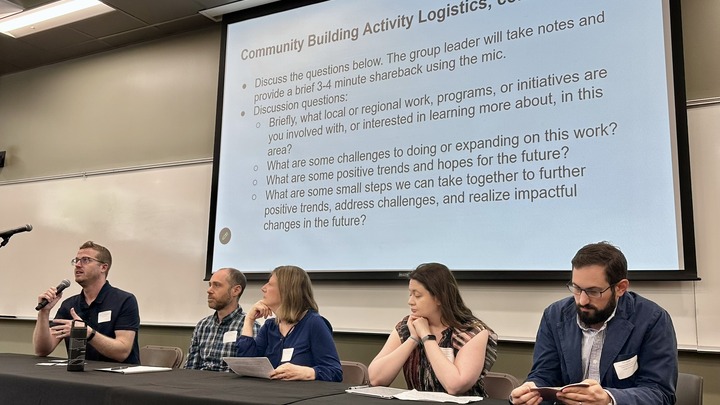
Discussion on open educational practices, open access publishing, institutional repositories, and community-driven infrastructure.

Community-building breakout sessions
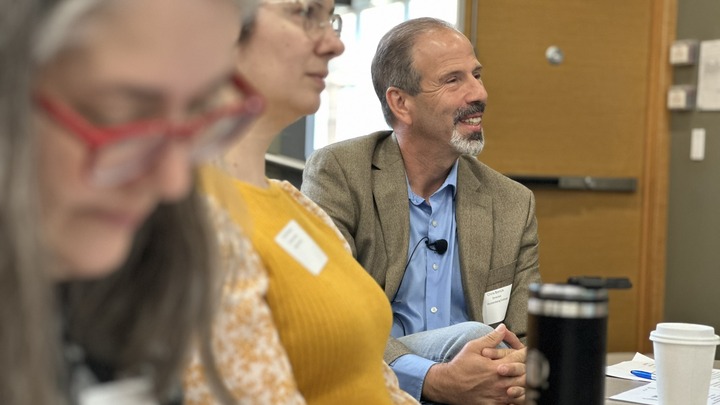
Lehigh University librarians, Heather Simoneau and Tricia Martone, along with keynote speaker, Dr. Christopher Borick, professor of political science at Muhlenberg College
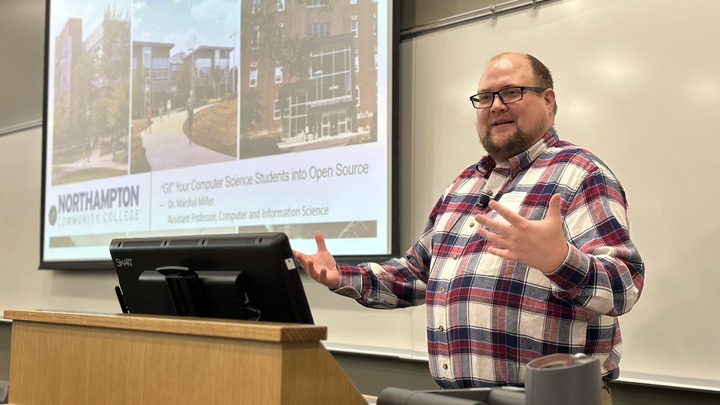
Dr. Marshal Miller, assistant professor of computer and information science at Northampton Community College, presents a lightening talk “‘Git’ Your Computer Science Students into Open Source” at the 2026 Lehigh Valley Open Knowledge Symposium
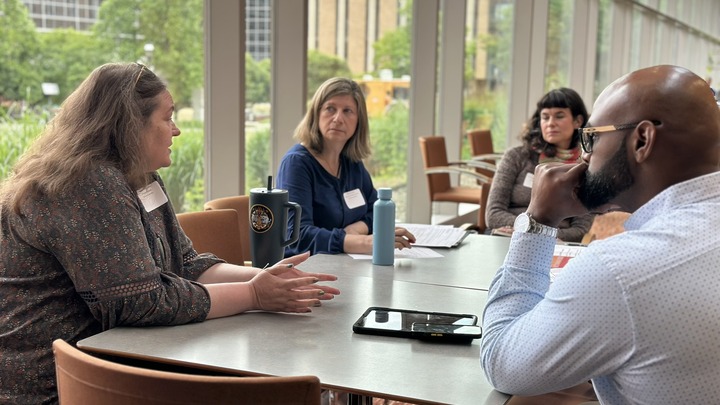
Symposium attendees meet in small groups for community-building discussions
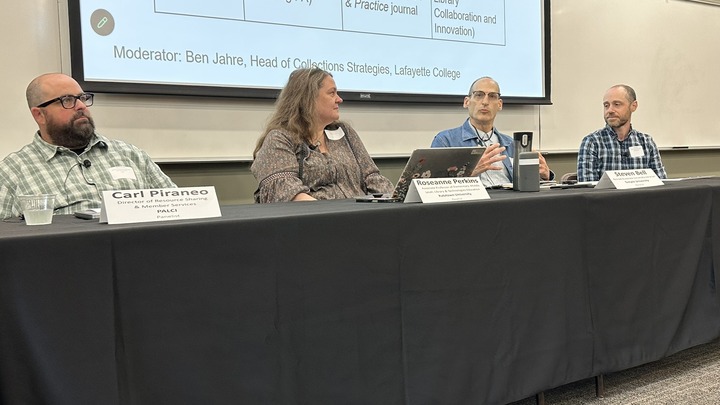
Afternoon panel, (l-r) Carl Piraneo, director of resource sharing and member services at PALCI (Partnership for Academic Library Collaboration and Innovation); Roseanne Perkins, associate professor of elementary, middle level, library and technologies education at Kutztown University; Steven Bell, retired associate university librarian at Temple University; and moderator Ben Jahre, head of collection strategies at Lafayette College
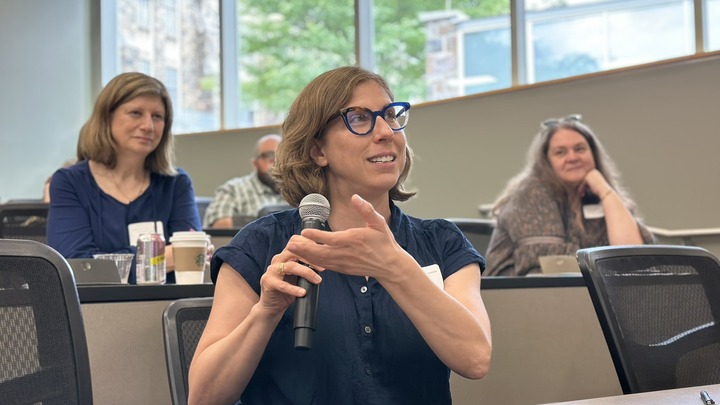
“The Small ‘p’ Politics of Open” panel discussion Q&A